


Join CHRONOHOLIC today!
All the watch news, reviews, videos you want, brought to you from fellow collectors
All the watch news, reviews, videos you want, brought to you from fellow collectors
.jpg)

Independent watchmaker Urwerk has never failed to turn heads with its highly complex wristwatch mechanisms. The brand has now introduced this signature architecture in a unique pocket watch, which also brings forth an elaborate hand-engraved titanium case – the UR-1001 Amadeus is a part of Urwerk’s Special Projects collection, a piece unique designed to display time from seconds and minutes all the way to centuries and a full millennium.
The UR-1001’s concept was born from an attempt to combine Urwerk’s satellite hours and minutes system with calendar indications. When the two satellite carousels proved too large for a wristwatch, the idea evolved into a pocket watch. The result is a mechanical “Zeit Device” that does more than simply tell the time.
Also Read: Urwerk introduces the UR-100V LS “LightSpeed” Ceramic
On the front, the flying satellite hours display sits at 6 o’clock, appearing to float without an upper bridge and revealing the retrograde minute mechanism beneath it. At 12 o’clock, a satellite annual calendar uses three orbital arms to display the months and automatically account for their different lengths of 28, 30, or 31 days.
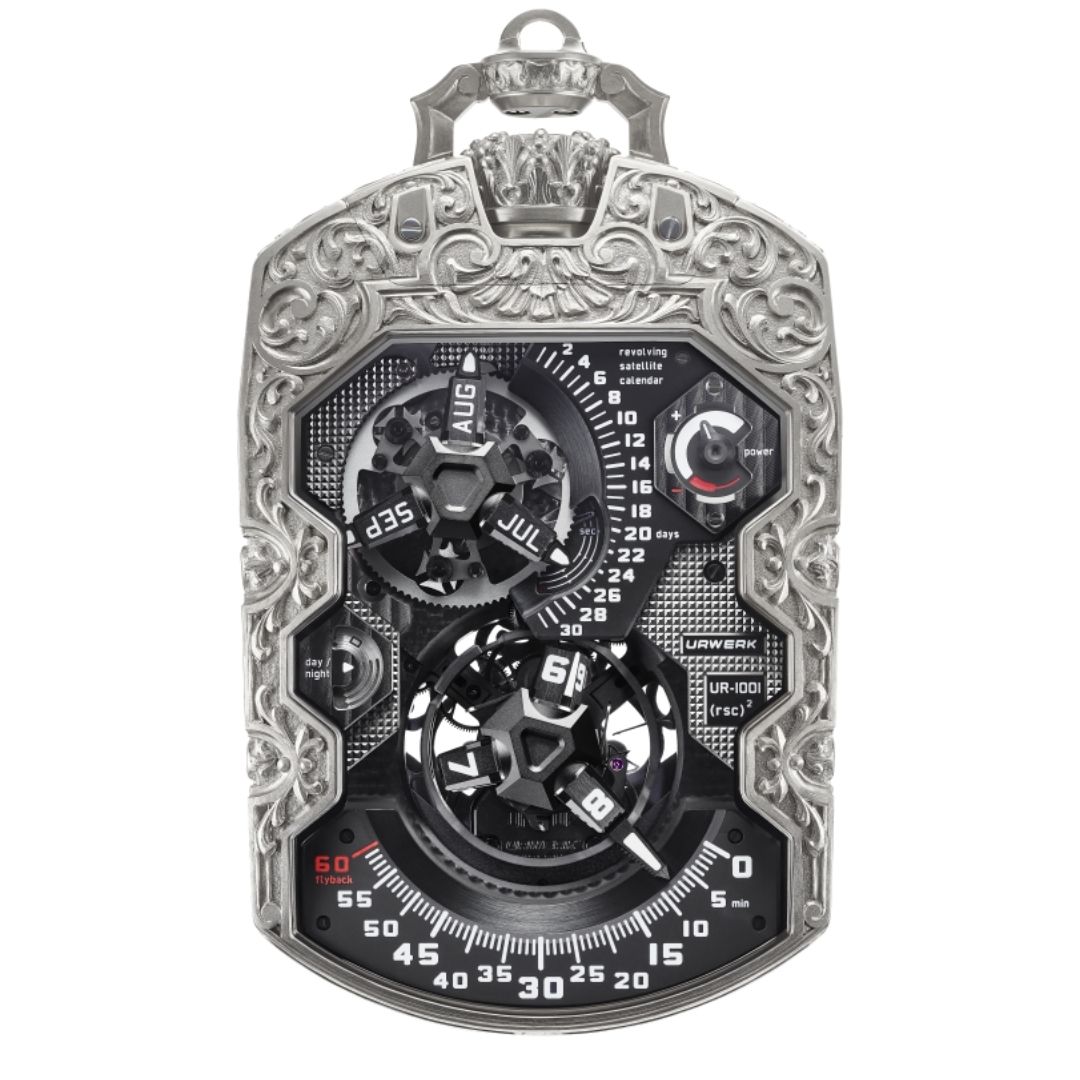
At 9 o’clock, a hand-painted day/night indicator contrasts a black Super-LumiNova night sky with a finely brushed white ruthenium-plated daytime surface, with intermediate markings representing dawn and dusk. The front also includes a 39-hour power-reserve indicator, while the seconds are displayed by three hands covering three 20-second segments across a 120-degree sector.
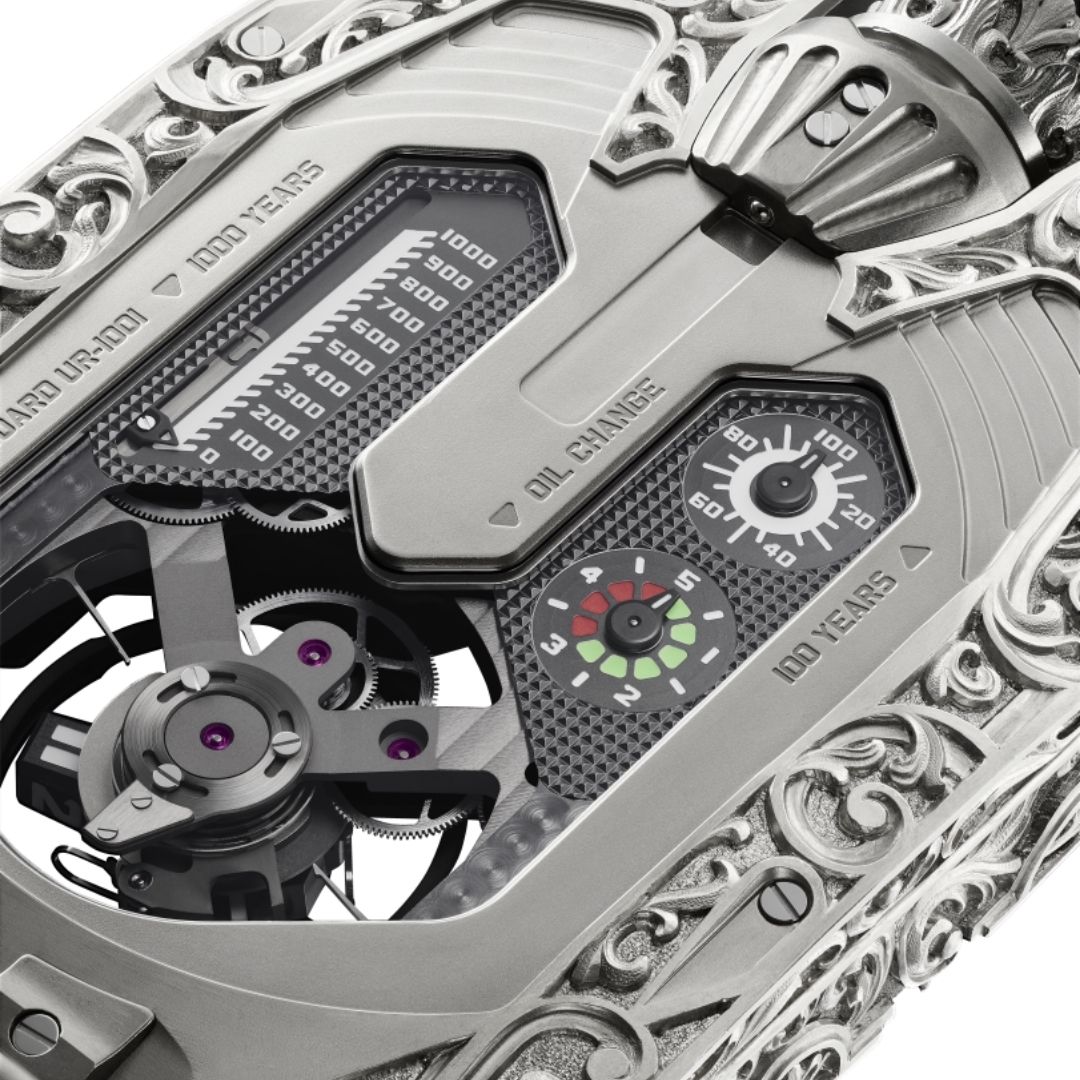
The reverse side extends the watch’s unusual approach to time. An “Oil Change” indicator monitors service intervals over five years – the first three years remain white, while the fourth and fifth years turn red to recommend servicing. Once serviced, the cycle resets. A second indicator records operation in five-year increments up to 100 years, while a further linear indicator extends the scale to 1,000 years.
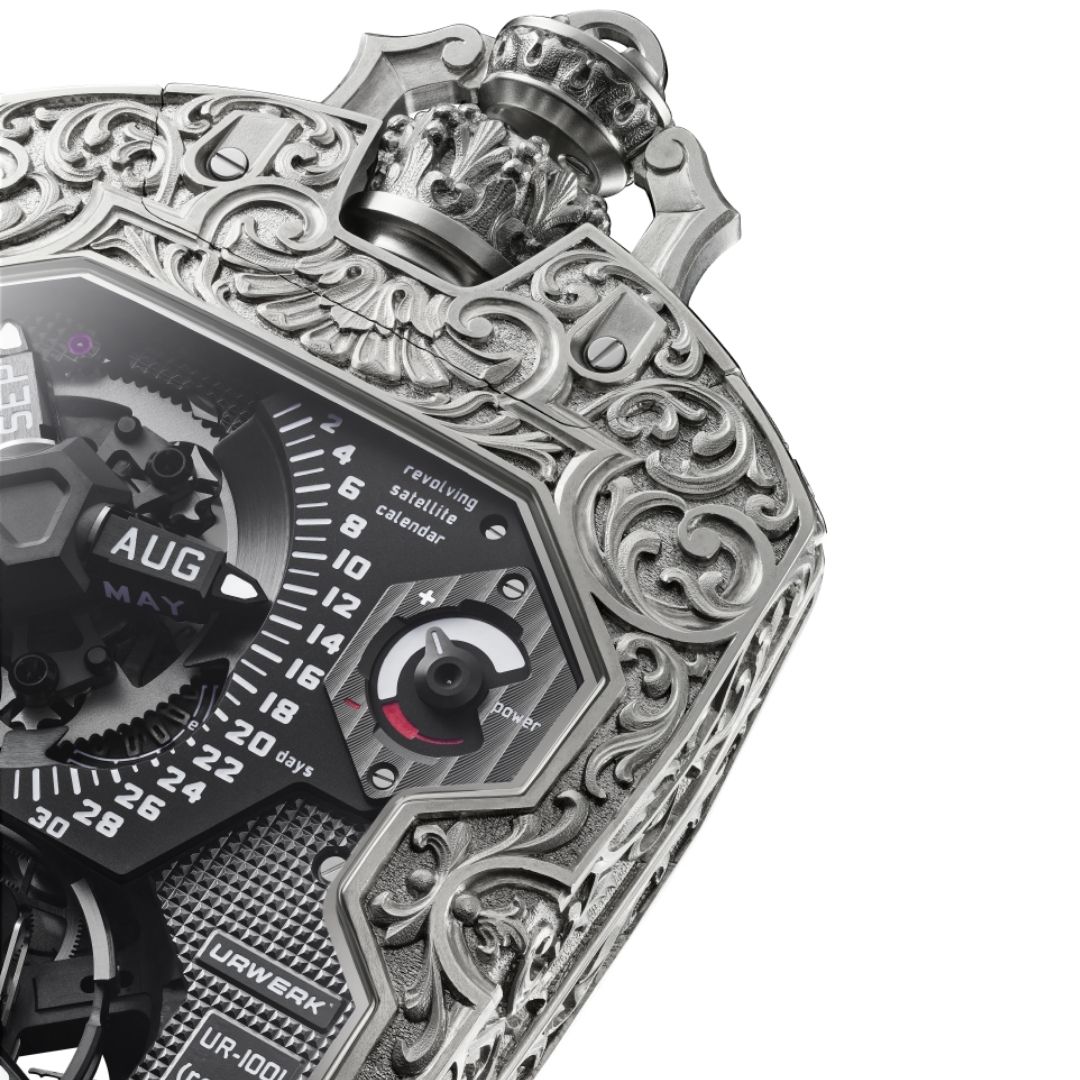
This mechanical architecture is built around Calibre UR-10.01, which contains 51 jewels and runs at 28,800 vibrations per hour (4 Hz). It uses a Swiss lever escapement, monometallic balance wheel, flat balance spring, and a single mainspring barrel offering 39 hours of power reserve. A unidirectional rotor handles the winding.
The movement features Urwerk’s co-axial double-star system, incorporating an aluminium ring and platinum counterweight, together with a shock-absorbing safety system. The calendar uses a 93-tooth wheel and three Maltese crosses, while the retrograde minutes rely on a 6.5-turn coil spring. Its movable balance-spring stud allows adjustment, while the long spring is designed to provide a particularly flat torque curve.
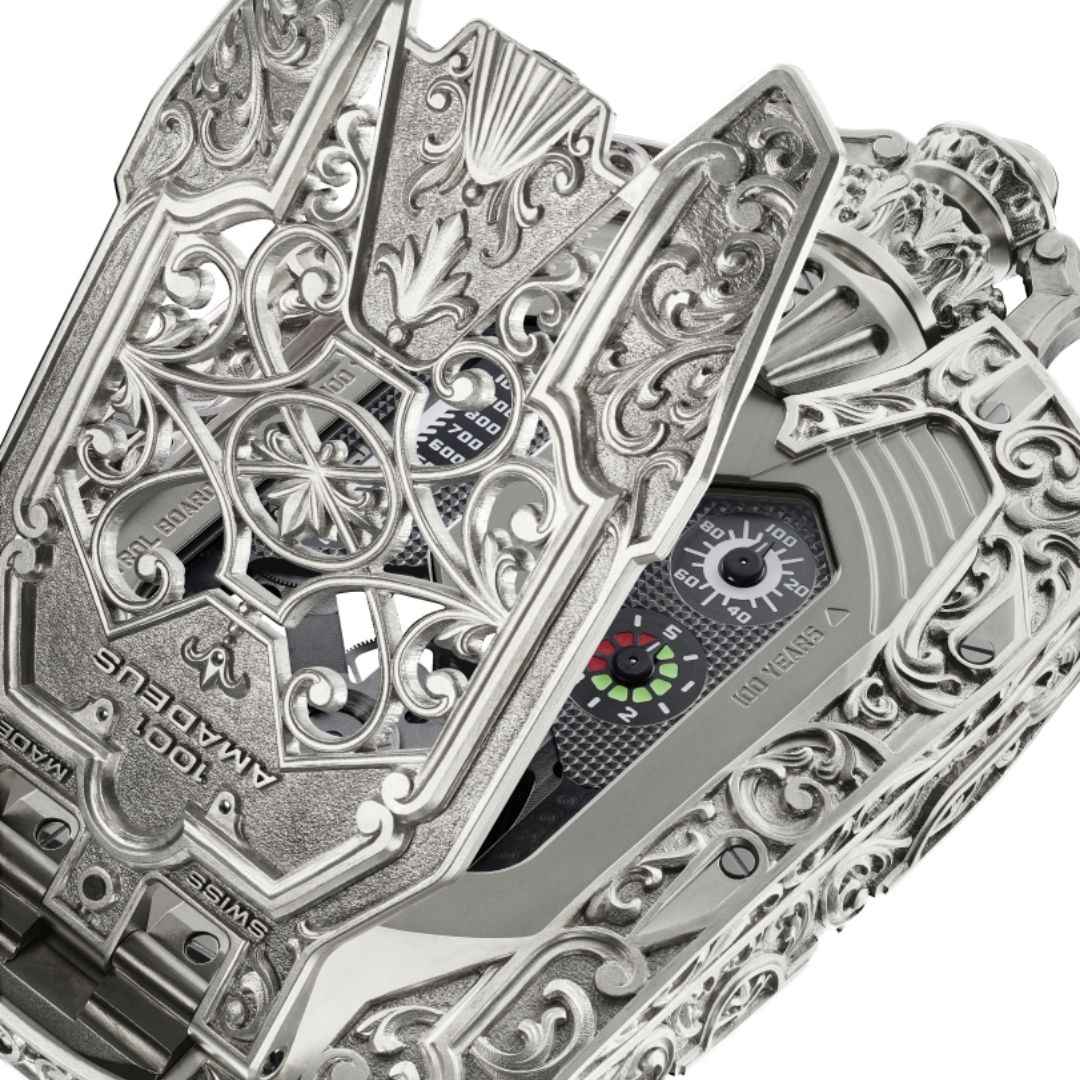
The main plates and bridges are made from ARCAP, with anti-oxidant titanium screws. The movement’s finishes include frosted plates decorated with a Côtes de Genève motif and DLC coating, alongside chamfered and polished screw heads.
Also Read: Urwerk closes the year with UR-230 “Black Star”
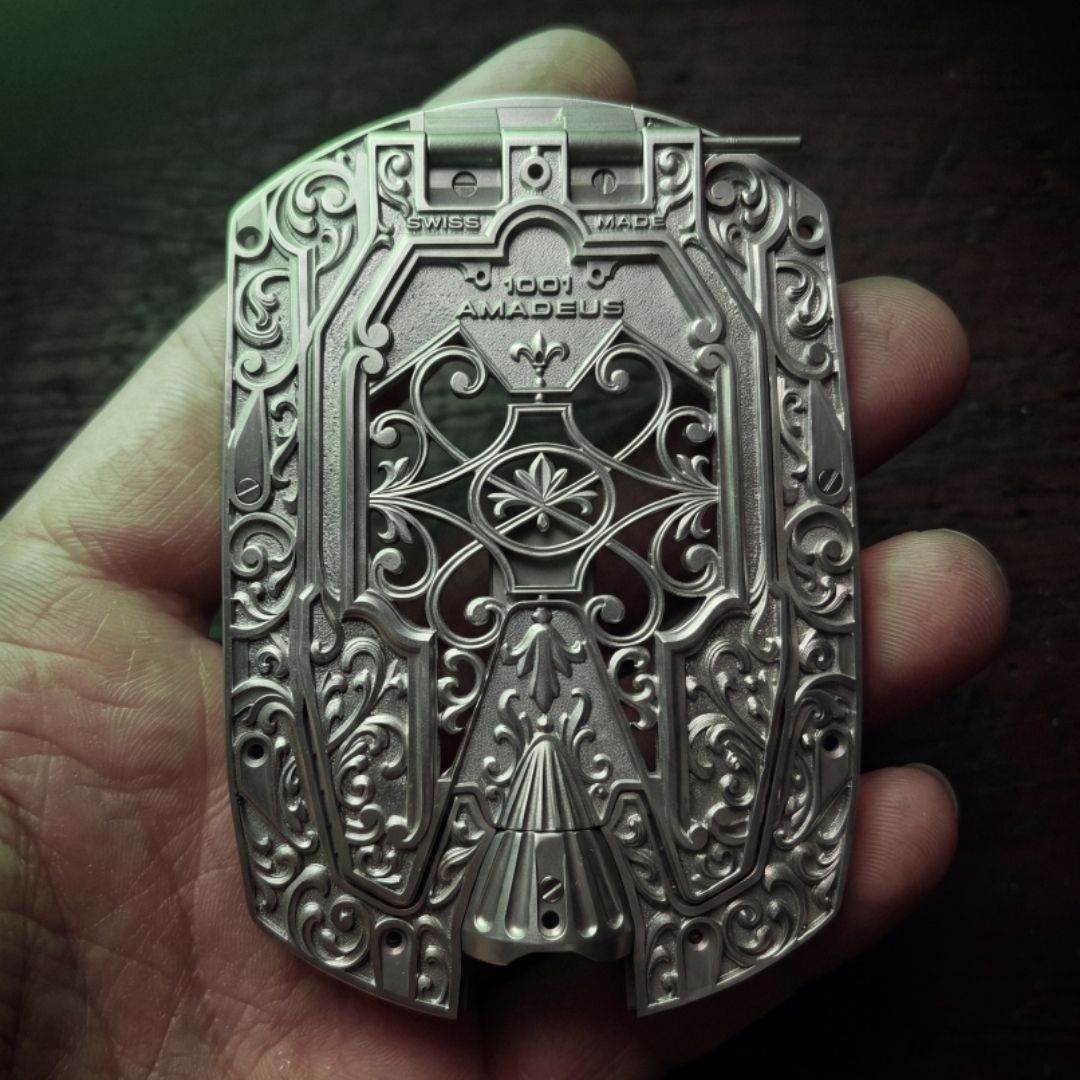
For the Amadeus edition, the case becomes an artwork in its own right. Urwerk entrusted German engraver Florian Güllert with transforming the raw titanium case through an elaborate Baroque-inspired engraving. The project required nearly three months, or around 500 hours, including the design process.
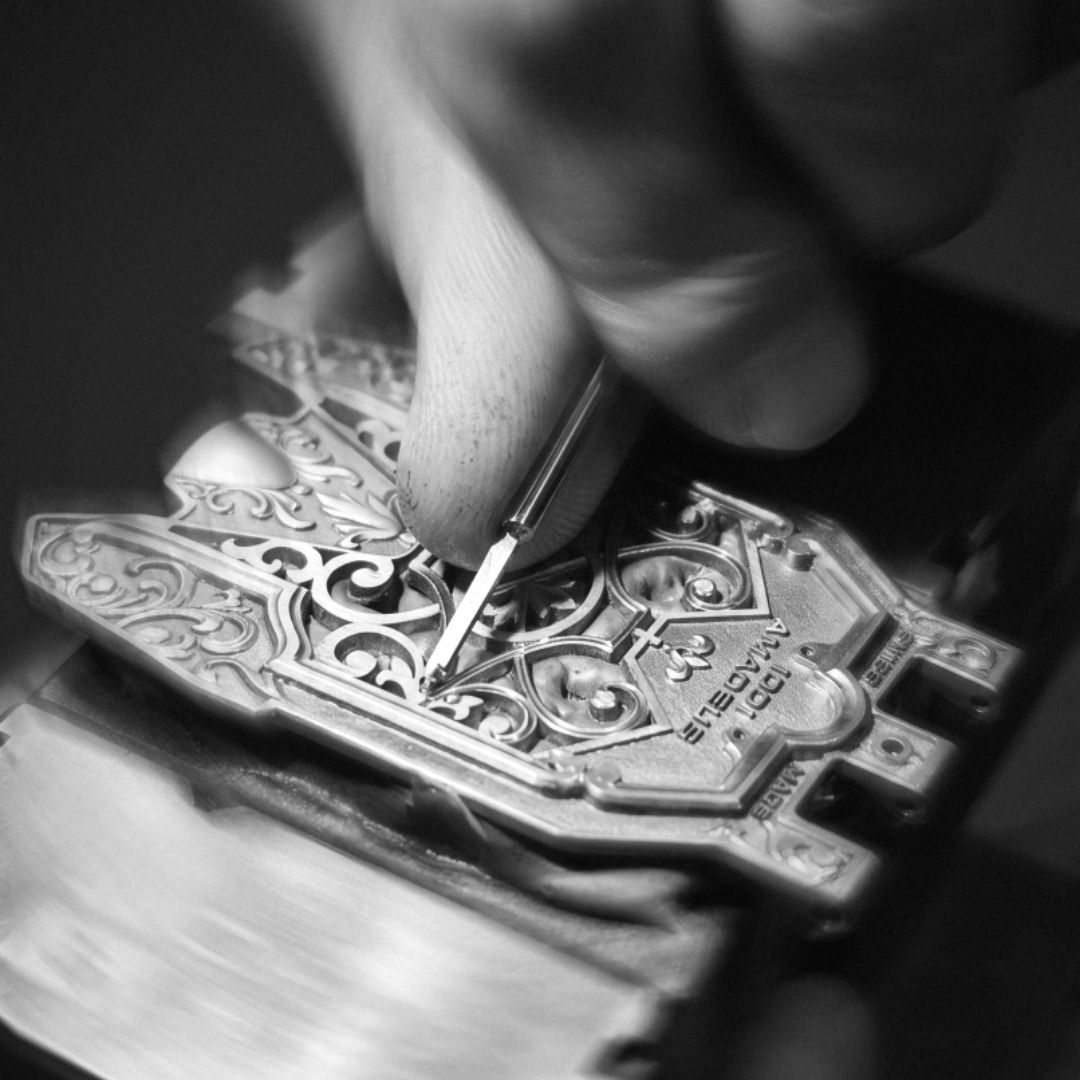
Güllert first rough-cut the titanium using a laser before carrying out the hand-finishing. Using a pneumatic chisel, he sculpted the metal with deep reliefs, arabesques, and contrasting textures. Backgrounds were dotted, satin-brushed, textured, or matt depending on the desired interaction with light, while the edges were individually refined with a file.
The unique case measures an imposing 106 mm × 62 mm × 23 mm and is made entirely from hand-engraved titanium. It uses glare-proofed sapphire crystals, is tested to 30 metres, and receives a bead-blasted finish alongside Güllert’s engraving.
The dial-side components include a sandblasted carousel, while the plates, dials, and satellites are treated with PE-CVD and DLC. The satellites receive satin-brushed and diamond-polished finishing, and the hour markers are treated with Super-LumiNova.
Images: Urwerk
Independent watchmaker Urwerk has never failed to turn heads with its highly complex wristwatch mechanisms. The brand has now introduced this signature architecture in a unique pocket watch, which also brings forth an elaborate hand-engraved titanium case – the UR-1001 Amadeus is a part of Urwerk’s Special Projects collection, a piece unique designed to display time from seconds and minutes all the way to centuries and a full millennium.
The UR-1001’s concept was born from an attempt to combine Urwerk’s satellite hours and minutes system with calendar indications. When the two satellite carousels proved too large for a wristwatch, the idea evolved into a pocket watch. The result is a mechanical “Zeit Device” that does more than simply tell the time.
Also Read: Urwerk introduces the UR-100V LS “LightSpeed” Ceramic
On the front, the flying satellite hours display sits at 6 o’clock, appearing to float without an upper bridge and revealing the retrograde minute mechanism beneath it. At 12 o’clock, a satellite annual calendar uses three orbital arms to display the months and automatically account for their different lengths of 28, 30, or 31 days.
At 9 o’clock, a hand-painted day/night indicator contrasts a black Super-LumiNova night sky with a finely brushed white ruthenium-plated daytime surface, with intermediate markings representing dawn and dusk. The front also includes a 39-hour power-reserve indicator, while the seconds are displayed by three hands covering three 20-second segments across a 120-degree sector.
The reverse side extends the watch’s unusual approach to time. An “Oil Change” indicator monitors service intervals over five years – the first three years remain white, while the fourth and fifth years turn red to recommend servicing. Once serviced, the cycle resets. A second indicator records operation in five-year increments up to 100 years, while a further linear indicator extends the scale to 1,000 years.
This mechanical architecture is built around Calibre UR-10.01, which contains 51 jewels and runs at 28,800 vibrations per hour (4 Hz). It uses a Swiss lever escapement, monometallic balance wheel, flat balance spring, and a single mainspring barrel offering 39 hours of power reserve. A unidirectional rotor handles the winding.
The movement features Urwerk’s co-axial double-star system, incorporating an aluminium ring and platinum counterweight, together with a shock-absorbing safety system. The calendar uses a 93-tooth wheel and three Maltese crosses, while the retrograde minutes rely on a 6.5-turn coil spring. Its movable balance-spring stud allows adjustment, while the long spring is designed to provide a particularly flat torque curve.
The main plates and bridges are made from ARCAP, with anti-oxidant titanium screws. The movement’s finishes include frosted plates decorated with a Côtes de Genève motif and DLC coating, alongside chamfered and polished screw heads.
Also Read: Urwerk closes the year with UR-230 “Black Star”
For the Amadeus edition, the case becomes an artwork in its own right. Urwerk entrusted German engraver Florian Güllert with transforming the raw titanium case through an elaborate Baroque-inspired engraving. The project required nearly three months, or around 500 hours, including the design process.
Güllert first rough-cut the titanium using a laser before carrying out the hand-finishing. Using a pneumatic chisel, he sculpted the metal with deep reliefs, arabesques, and contrasting textures. Backgrounds were dotted, satin-brushed, textured, or matt depending on the desired interaction with light, while the edges were individually refined with a file.
The unique case measures an imposing 106 mm × 62 mm × 23 mm and is made entirely from hand-engraved titanium. It uses glare-proofed sapphire crystals, is tested to 30 metres, and receives a bead-blasted finish alongside Güllert’s engraving.
The dial-side components include a sandblasted carousel, while the plates, dials, and satellites are treated with PE-CVD and DLC. The satellites receive satin-brushed and diamond-polished finishing, and the hour markers are treated with Super-LumiNova.
Images: Urwerk


.png)
.png)
.png)

